Believing in Allah: The Islamic Understanding of the One True God
Believing in Allah is the foundation of Islam. Muslims believe in one God, the Creator of the heavens and the earth, who has no partners, no children, no equal, and no limitations. This belief is called Tawheed, the purest form of monotheism.
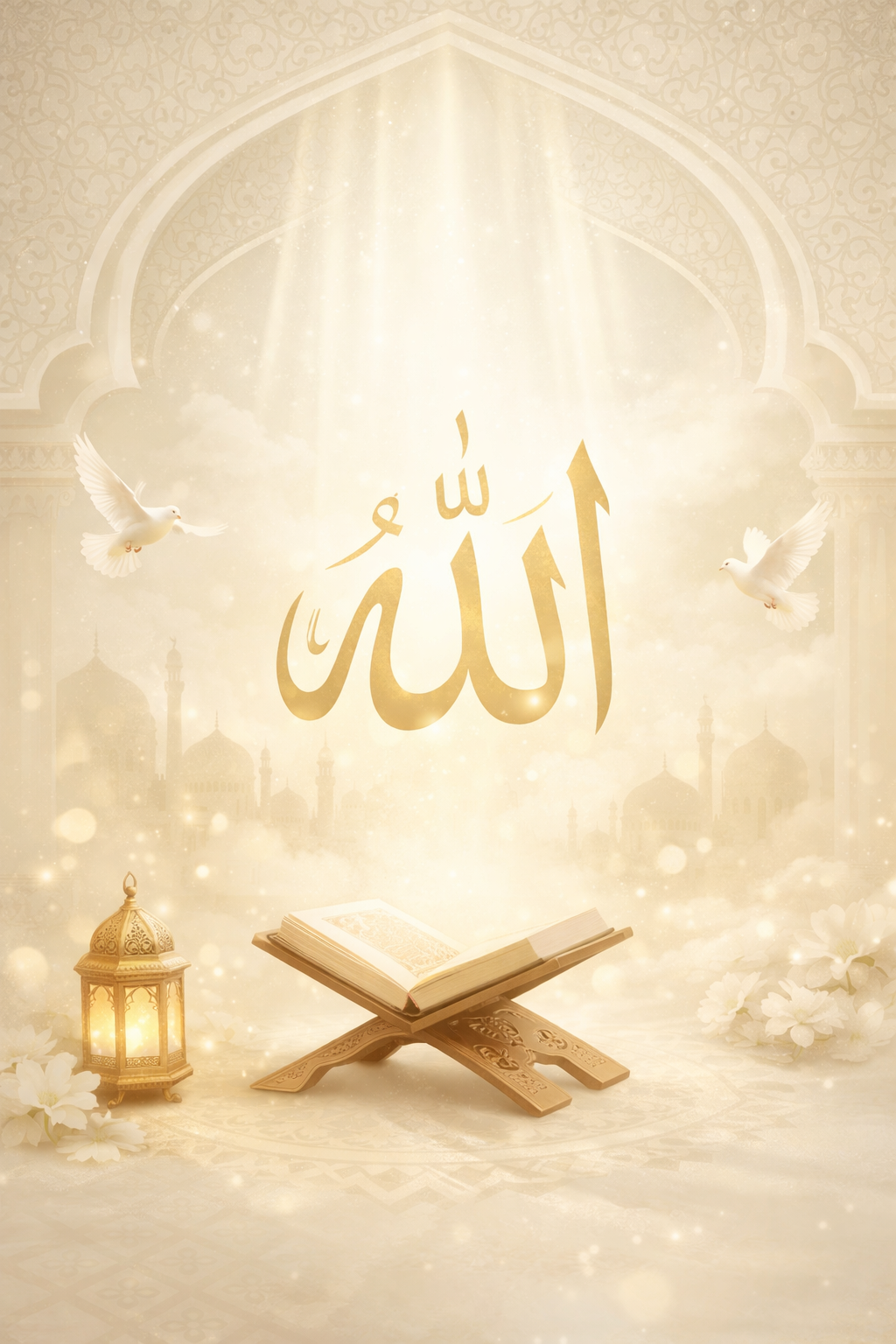
Elegant Islamic illustration showing the word Allah in golden Arabic calligraphy glowing under soft light, with two white doves flying near ornate arches, an open Quran on a wooden stand, and a lantern beside white flowers — symbolizing peace, faith, and divine light.

What Does the Name “Allah” Truly Mean in Islam?

The name “Allah” refers to the One True God — the eternal Creator who has no partners, no children, no equal, and no limitations. It is not a name invented by Muslims; it is the original Arabic word for God used by prophets, scholars, and even Arabic‑speaking Christians and Jews. When Muslims say “Allah,” they are speaking about the same God worshipped by Abraham, Moses, and Jesus — the One who created the universe, sustains every soul, and deserves all worship.

1️⃣ The Linguistic Meaning of “Allah”

The word “Allah” comes from the Arabic term Al‑Ilah, meaning “The One God.” Over time, the two words merged into “Allah,” a name that cannot be made plural or feminine — perfectly matching the Islamic belief that God is One, Unique, and unlike His creation.

2️⃣ Allah in the Scriptures of Earlier Prophets

Muslims believe that Allah is the same God worshipped by Abraham, Moses, David, and Jesus. The concept of one universal Creator is consistent across all divine revelations, showing that Islam continues the same pure monotheism taught by earlier prophets.

3️⃣ Why Arabic‑Speaking Christians Also Say “Allah”

n Arabic Bibles and churches, Christians use the word “Allah” when referring to God. This proves that “Allah” is not a separate or new deity — it is simply the Arabic word for the One God, used by people of different faiths long before Islam.

4️⃣ Allah Is Not a “Muslim God” but the God of All Creation

Islam teaches that Allah is the Creator of every human being, not only Muslims. He provides for all, protects all, and judges all with perfect justice. The Qur’an repeatedly states that Allah is “Lord of the Worlds,” not the God of one tribe or nation.

5️⃣ How the Name “Allah” Reflects Pure Monotheism

Unlike other languages where the word “god” can be pluralized or modified, the name “Allah” cannot be changed. It has no plural form and no gender form, which protects the meaning of pure monotheism — that God is One, Eternal, and Unique.

6️⃣ Why Muslims Love and Use the Name “Allah” Daily

Muslims use the name “Allah” in prayer, gratitude, patience, and remembrance. Saying “Allah” brings peace to the heart, strengthens faith, and reminds believers that their Creator is always near, always listening, and always guiding.

Why Do Muslims Believe in Allah?

Muslims believe in Allah because He is the One True God who created the universe, provides for every living being, and guides humanity through revelation. This belief is rooted in clear signs in creation, the teachings of all prophets, and the natural instinct within every human heart to recognize a single, perfect Creator.

The Three Types of Tawheed (Oneness of Allah)

The name “Allah” refers to the One True God — the eternal Creator who has no partners, no children, no equal, and no limitations. It is not a name invented by Muslims; it is the original Arabic word for God used by prophets, scholars, and even Arabic‑speaking Christians and Jews. When Muslims say “Allah,” they are speaking about the same God worshipped by Abraham, Moses, and Jesus — the One who created the universe, sustains every soul, and deserves all worship.

Tawheed A‑Rububiyyah (Oneness in Lordship)

Tawheed ar‑Rububiyyah means believing that Allah alone is the Creator, the Owner, and the Controller of the entire universe. Nothing exists, moves, grows, or changes except by His will. He gives life and death, provides for every creature, and manages every moment with perfect wisdom. Recognizing Allah’s Lordship frees a person from fear of creation and connects the heart directly to the One who controls all affairs.

Tawheed Ar‑Rububiyyah (Oneness in Lordship)

Tawheed ar‑Rububiyyah means believing that Allah alone is the Creator, the Owner, and the Controller of the entire universe. Nothing exists, moves, grows, or changes except by His will. He gives life and death, provides for every creature, and manages every moment with perfect wisdom. Recognizing Allah’s Lordship frees a person from fear of creation and connects the heart directly to the One who controls all affairs.

Tawheed Al‑Uluhiyyah (Oneness in Worship)

Tawheed al‑Uluhiyyah means that only Allah deserves our worship — our prayers, hopes, fears, love, trust, and obedience. Muslims do not worship prophets, saints, idols, graves, planets, or spirits. Worship belongs to Allah alone because He alone created us, sustains us, and answers our prayers. This is the pure monotheism taught by all prophets, from Adam to Muhammad ﷺ.

Attributes of Allah (Names & Qualities)

Allah’s attributes describe His perfection, power, knowledge, mercy, and uniqueness. These qualities help Muslims understand who their Creator is and how He relates to His creation.
Allah Is All‑Knowing (Al‑‘Aleem)
Allah’s knowledge is perfect, complete, and unlimited. Nothing in the heavens or the earth is hidden from Him — not a leaf that falls, not a thought in the heart, not a whisper in the dark. He knows the past, present, and future with absolute precision. His knowledge is not gained, learned, or improved; it has always been perfect and will always remain perfect.

Allah knows:

  • What we reveal and what we hide

  • What we fear and what we hope for

  • What is best for us even when we don’t understand

  • Every detail of creation, from galaxies to atoms

Believing that Allah is All‑Knowing brings peace to the heart. It reminds us that we are never alone, never forgotten, and never unseen — our Creator understands us completely

Allah Is All‑Powerful (Al‑Qadeer)
Allah Is All‑Powerful Allah’s power has no limits, no weakness, and no boundaries. He is the One who created the universe from nothing, controls every moment of existence, and can do whatever He wills with perfect wisdom. Nothing is difficult for Him — whether it is the creation of a star, the movement of a leaf, or the answering of a believer’s dua.

Allah’s power includes:

  • The ability to create and recreate

  • The ability to give life and cause death

  • The ability to change any situation instantly

  • The ability to protect, heal, and guide

  • The ability to decree what is best for every soul

Believing that Allah is All‑Powerful fills the heart with strength and hope. It reminds us that no problem is too big, no hardship is too heavy, and no dream is impossible when the One who controls everything is on our side.
Allah Is Most Merciful
Allah’s mercy surrounds every moment of our lives — seen and unseen, known and unknown.

Allah’s mercy includes:

  • Mercy in creating us and giving us purpose

  • Mercy in forgiving sins, no matter how many

  • Mercy in guiding hearts toward truth

  • Mercy in protecting us from harm we never even knew

  • Mercy in rewarding every good deed, even the size of a seed

His mercy is greater than the mercy of a mother for her child, deeper than the ocean, and wider than the heavens and the earth. Believing in Allah’s mercy fills the heart with hope, comfort, and trust — knowing that no matter how far we fall, His door is always open

Allah Is All‑Seeing
Allah sees everything in the heavens and the earth — every action, every moment, every tear, every intention

Allah’s perfect sight means:

  • He sees every injustice and will bring justice

  • He sees every good deed, even if forgotten by people

  • He sees every struggle, every sacrifice, every silent prayer

  • He sees the pain in the heart before it becomes words

Believing that Allah is All‑Seeing brings comfort and accountability. It reminds us that our efforts are never wasted and our hardships are never ignored — our Creator sees everything with perfect clarity and perfect mercy.

Allah Is All‑Hearing -
Qur’an 2:186 — Allah Is Near and Responds to Prayers
وَإِذَا سَأَلَكَ عِبَادِي عَنِّي فَإِنِّي قَرِيبٌ ۖ أُجِيبُ دَعْوَةَ الدَّاعِ إِذَا دَعَانِ

English Meaning

“When My servants ask you about Me, I am near. I respond to the call of the one who calls upon Me.”

Allah hears every sound — loud or soft, public or private, spoken or unspoken.
His hearing is perfect and unlimited. He hears the whisper of a heart before it becomes a word, the dua made in the middle of the night, the tear that falls without a voice, and the silent pain that no one else notices.

Allah’s perfect hearing means:

  • He hears every dua, even if it is repeated a thousand times

  • He hears every injustice and will respond with justice

  • He hears every cry for help, even when no one else is around

  • He hears the gratitude, the patience, and the quiet remembrance in the heart

His hearing is not like the hearing of creation — it has no limits, no weakness, and no boundaries. Believing that Allah is All‑Hearing brings comfort and confidence, because a believer knows that every prayer reaches Him, and nothing is ever ignored or lost

Allah Is Just and Wise Allah’s justice is perfect, and His wisdom is flawless.

He never wrongs anyone, never makes a mistake, and never judges unfairly. Every action He decrees — whether we understand it or not — is based on complete knowledge, absolute justice, and infinite wisdom. Nothing He does is random, and nothing in creation happens without purpose.

Allah’s perfect justice means:

  • Every good deed is rewarded, even if small

  • Every injustice will be corrected, if not now, then on the Day of Judgment

  • No soul will carry the burden of another

  • No suffering is ignored or forgotten

Allah’s perfect wisdom means:

  • He knows what we do not know

  • He sees what we cannot see

  • He plans with knowledge of the past, present, and future

  • He gives, withholds, delays, or changes things for reasons filled with mercy

Believing that Allah is Just and Wise brings deep peace. It reminds us that life is not chaos — it is guided by a Lord who is fair, purposeful, and compassionate in every decree.

Common Misunderstandings About Allah

The name “Allah” refers to the One True God — the eternal Creator who has no partners, no children, no equal, and no limitations. It is not a name invented by Muslims; it is the original Arabic word for God used by prophets, scholars, and even Arabic‑speaking Christians and Jews. When Muslims say “Allah,” they are speaking about the same God worshipped by Abraham, Moses, and Jesus — the One who created the universe, sustains every soul, and deserves all worship.

1️⃣ “Allah” Is Not a Different God

Many people think “Allah” is a separate or new God, but this is incorrect. “Allah” is simply the Arabic word for The One God — the same God worshipped by Abraham, Moses, and Jesus. Arabic‑speaking Christians and Jews also use the word “Allah” in their Bibles and prayers. Islam teaches continuity, not a new deity.

2️⃣ Muslims Do Not Worship Muhammad ﷺ

Some believe Muslims worship Prophet Muhammad ﷺ, but Islam strictly forbids worshipping any human. Muslims love and follow the Prophet, but worship is for Allah alone. Muhammad ﷺ is a messenger — not divine, not a partner with God, and not someone who receives worship or prayers.

3️⃣ Allah Is Not a “Moon God”

A common myth claims Allah is a moon god because Islam uses a lunar calendar. This is historically false. Islam rejects all idol worship, including sun, moon, or star worship. The Qur’an clearly states that the moon is only a creation of Allah, not a deity. The lunar calendar is simply a method of timekeeping, not a symbol of worship.

4️⃣ Muslims Do Not Worship the Kaaba

Some think Muslims worship the Kaaba because they face it during prayer. In reality, the Kaaba is a direction, not a god. Muslims face one direction to maintain unity and discipline in prayer. Worship is directed to Allah alone — not to the building, not to the stone, and not to any physical object.


4️⃣ The Importance of Believing in Allah

The Importance of Believing in Allah Belief in Allah gives life purpose, direction, and inner peace. It connects a person to their Creator, explains why we exist, and guides how we should live. When someone believes in Allah, they understand that life is not random — every moment has meaning, every hardship has wisdom, and every good deed has reward. This belief shapes a person’s character, strengthens patience, inspires gratitude, and builds a deep sense of responsibility toward others. It is the foundation of morality, justice, and compassion in Islam.


4️⃣ How Belief in Allah Shapes a Muslim’s Daily Life

How Belief in Allah Shapes Daily Life Believing in Allah influences every part of a Muslim’s life — thoughts, actions, habits, and relationships. A Muslim prays because they know Allah hears. They avoid sin because they know Allah sees. They trust the future because they know Allah plans with wisdom. They show kindness because Allah loves mercy. They stay humble because everything they have is from Him.

This belief creates a life filled with purpose, discipline, gratitude, and hope. It transforms ordinary actions — eating, working, sleeping, helping others — into acts of worship when done with the right intention.

Frequently Asked Questions About Allah

1️⃣ Is “Allah” the same God worshipped by Christians and Jews?
Yes. “Allah” is simply the Arabic word for The One God. Arabic‑speaking Christians and Jews also use the word “Allah” in their Bibles and prayers. Islam teaches that Allah is the same God who sent Abraham, Moses, and Jesus.
2️⃣ Why does Islam say Allah has no partners or children?
3️⃣ Why can’t Muslims draw or picture Allah?
4️⃣ Do Muslims worship Muhammad ﷺ?
5️⃣ Why do Muslims face the Kaaba when praying?
6️⃣ If Allah is merciful, why do hardships happen?
7️⃣ How do Muslims know Allah hears their prayers?
8️⃣ Is Allah only the God of Muslims?
9️⃣ Can Allah forgive any sin?
🔟 Where is Allah?

Conclusion 
Understanding Allah
Believing in Allah is the foundation of a meaningful, peaceful, and guided life.

When a person understands who Allah is — His Oneness, His power, His mercy, His justice, and His wisdom — the heart becomes calm, the mind becomes clear, and life gains direction. Islam teaches that Allah is not distant or unreachable; He is close, caring, and always aware of our struggles, hopes, and prayers.

Knowing Allah helps a person:

  • Live with purpose instead of confusion

  • Face hardship with patience and trust

  • Show kindness, humility, and gratitude

  • Build a strong moral character

  • Feel connected to something greater than this world

    Every prophet, from Adam to Muhammad ﷺ, came with the same message: Worship the One God, rely on Him, and walk through life with faith and goodness.

    Understanding Allah is not just knowledge — it is a journey of the heart. And every step taken toward Him is met with mercy, guidance, and light.

About Us

An Islamic educational website providing simple, clear answers about Allah, the Qur’an, the Prophets, and Islamic beliefs — based on authentic sources

Disclaimer

Answers are based on Qur’an and authentic Sunnah. For personal matters, please consult a qualified scholar. We strive for accuracy, but human error is possible
Created by Keasites.com 
© Copyright 2026 Islamqaenglish.online